battery machine and materials solution

핫 제품

Patent CN215506637U - Vibrating-Screen Feeding Device

Sep 29,2026
GRANTED UTILITY MODEL · CN215506637U · ACTIVE
Vibrating-Screen Feeding Device for Large Mixers

Screens caked lumps out of powder before it reaches the mixer, then conveys it in - so a large mixer can be fed safely while it keeps running.

Full specification and drawings: CN215506637U on Google Patents

Battery slurry starts as solid or powdered raw material - and powder left standing cakes. Lumps that reach the mixer degrade mixing quality, and the hardest lumps can damage the mixer itself. Yet the two feeding methods then in use had their own problems: manual feeding gave the operator little protection and was inefficient, and vacuum feeding was expensive with complex vibration equipment. Neither could add material while the mixer was running.

CN215506637U, filed on 9 September 2021, solves both sides of the problem. It screens the raw material before it ever enters the mixer, and it drives the screen mechanically from the same motor that turns the screw conveyor - no separate vibrator, no extra actuator.

Patent Information

Publication number CN215506637U
Application number CN202122171553.1U
Title (original) 一种基于大型搅拌机用上料装置 (Vibrating-Screen Feeding Device for Large Mixers)
Inventors Huang Zhengyao (Dany Huang); Chen Lucai (Tobey Chen)
Current assignee XIAMEN TOB NEW ENERGY TECHNOLOGY Co., Ltd. - the registered entity of TOB NEW ENERGY
Filing date 9 September 2021
Grant date 14 January 2022
Document type Utility model (granted, kind code U)
Legal status Active
Anticipated expiration 9 September 2031
Forward citations Cited by 1 subsequent patent
Drawings 5 figures
Official record CN215506637U on Google Patents
Ownership. TOB NEW ENERGY holds this granted utility model. It was filed under the company's registered Chinese entity (rendered in the page source and structured data) and is co-invented by Dany Huang (Zhengyao Huang) and Tobey Chen.
About titles and terminology on this page. The English title above is a human-reviewed translation by TOB NEW ENERGY's engineering team, standardised to the terminology used across our equipment line; it is not a machine rendering. The original Chinese title and claims are the authoritative text - a reader comparing this page with Google Patents may notice wording differences precisely because the public record there is machine-translated. Figures and mechanism descriptions on this page are drawn from the Chinese specification and claims, not from any translation of them.
A note on patent type. This is a Chinese utility model patent, which protects the mechanical structure of a device rather than a chemical formulation or process. Utility models carry a ten-year term and are examined for novelty and practical applicability. What follows is therefore a structural description - the claims define an apparatus, and the specification does not publish measured performance figures. Any throughput or tolerance numbers for TOB's production machines come from our equipment datasheets, not from this patent document.

The Production Problem This Patent Solves

Powdered raw materials for lithium battery slurry tend to agglomerate while stored. The specification lists the consequences in order of severity: caked lumps reduce stirring quality, and lumps that have hardened can even break the mixer itself. On the feeding side, manual loading puts the operator beside a running machine with no real protective measures and cannot keep up with production; vacuum loading needs expensive equipment and complex vibration hardware. The result the patent is after is stated in its abstract: raw material that is screened before the mixer, an operator who can stay away from the mixer, and a device that can add material while the mixer keeps mixing.

How the Mechanism Works

Inlet and screening

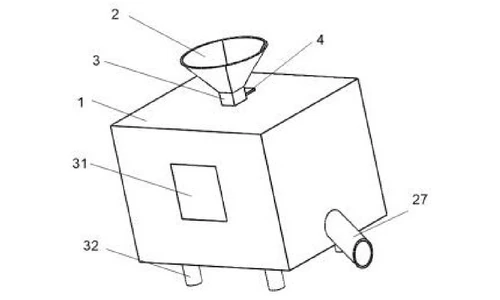
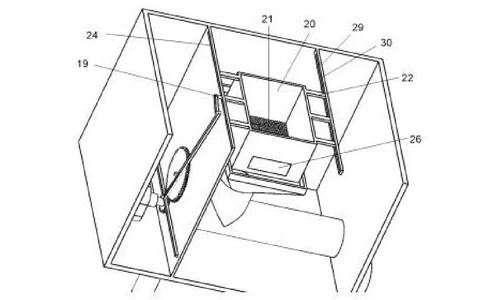
The device is a box body (1) standing on support columns (32). Material is poured into the feed funnel (2) at the top, passes a feed opening (3) closed by a baffle (4), and lands on the vibrating screen (20). The screen mesh (21) is inserted into a mesh groove (25) at the bottom of the screen frame, so the mesh can be replaced to change the cut size. A screen door (26) opens so the residue left on the mesh - the lumps - can be taken out.

Overall structure of the feeding device
Figure 1 - overall structure of the feeding device
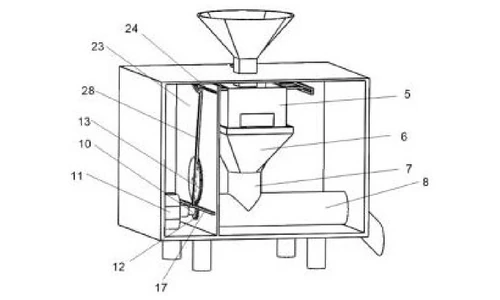
Internal structure of the feeding device
Figure 2 - internal structure of the feeding device

One motor, two jobs: conveying and shaking

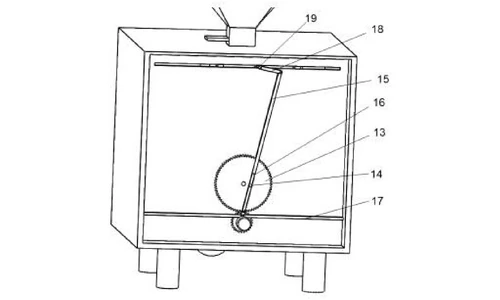
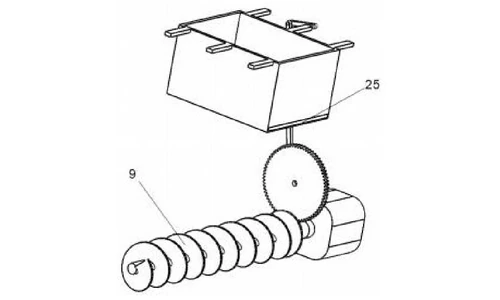
The motor (11) turns a rotating shaft (10) by a coupling. The shaft drives a screw shaft (9) inside the horizontal pipe (8) - the conveying job - and carries a pinion (12) that meshes with a large gear (13) above it - the shaking job. A cylindrical pin (14) fixed on the large gear rides in a rectangular groove (16) of a first link (15), whose lower end is pivoted on a cross bar (17) as a rotating pair. As the gear turns, the pin swings the link, and a second link (18) carries that motion to a slider (19). Rotary motion of the gear is thus converted into the reciprocating motion of the slider, and the slider shakes the screen.

Linkage mechanism that converts gear rotation into screen vibration
Figure 3 - the linkage mechanism
Vibrating screen assembly
Figure 4 - the vibrating screen assembly

Stable screen travel

The screen rests on six screen handles (22). The slider acts on the right-middle handle, while the left end of every handle rides in a transverse groove (30) on a cross bar (29); the slider itself runs in the slide groove (24) of a partition plate (23). The specification credits this arrangement with keeping the screen vibration stable, and it also protects the operator: all moving parts are inside the box, which has a side door (31) for inspection and residue removal.

Conveying into the mixer

Screened powder falls through a square funnel (6) and a vertical pipe (7) into the horizontal pipe (8). There the rotating screw shaft (9) pushes it along to the discharge port (27), which leads into the mixer below. Because material is conveyed mechanically and the screen needs no separate vibrator, the device can feed the mixer while mixing is in progress.

Screw conveyor shaft inside the horizontal pipe
Figure 5 - the screw conveyor shaft

Claimed Benefits

Benefit Mechanism responsible
Agglomerates removed before they reach the mixer Vibrating screen above the conveying path
Simple, low-cost vibration Gear-and-two-link mechanism driven by the conveyor motor itself
Feeding while the mixer runs Mechanical conveying through vertical and horizontal pipes to the discharge port
Operator stays away from the running mixer Enclosed box with the operator-side feed funnel and controlled discharge
Easy maintenance and residue removal Replaceable mesh, screen door and side box door
Stable screening motion Six screen handles with the slider acting on the right-middle handle

How It Compares with Manual Mixer Loading

Powdered raw materials agglomerate in storage: caked lumps reduce stirring quality and hardened lumps can even break the mixer. Manual loading also puts the operator beside a running machine. This device screens and conveys instead.

Dimension Conventional approach This patent design
Lump control Caked powder reaches the stirrer Vibrating screen removes agglomerates above the conveying path
Operator safety Manual loading beside a running mixer Enclosed box with operator-side feed funnel and controlled discharge
Drive Separate shaker equipment to buy and maintain Conveyor motor also drives the screen through a gear-and-two-link mechanism

Where This Technology Is Used Today

This patent covers the pre-mixer feeding stage of TOB's slurry preparation line. Screening first, then conveying - with no separate vibrator to buy or maintain - is how our feeding equipment protects large mixers from caked raw material.

Related equipment enquiries: request a quote

Frequently Asked Questions

What does patent CN215506637U cover?

It covers a feeding device for large-scale mixers: a box with a top feed funnel, a mechanically shaken vibrating screen that removes agglomerates, and a screw conveyor that delivers the screened powder out of a discharge port into the mixer. The screen is shaken by a gear-and-linkage mechanism driven by the same motor that turns the screw shaft.

Why screen the raw material before mixing at all?

Solid and powdered raw materials cake while stored. Lumps reduce stirring quality, and lumps that have hardened can damage the mixer itself. Screening them out before the material enters the mixer is the pre-treatment the specification calls for.

How is the screen vibrated without a separate vibrator?

The conveyor motor drives a shaft that carries both the screw shaft and a pinion. The pinion turns a large gear, and a cylindrical pin on the gear swings a two-link mechanism that makes a slider reciprocate - so the gear's rotation is converted into the screen's reciprocating vibration with very few parts.

Can the device feed the mixer while mixing is in progress?

Yes. Material is screened inside an enclosed box and conveyed mechanically through pipes to the discharge port, so the operator does not stand beside the running mixer, and feeding does not require the mixer to stop.

How are lumps and residue removed from the screen?

The vibrating screen has a screen door for taking out the residue left after screening, and the mesh itself is inserted into a groove at the bottom of the screen frame so it can be replaced. A side door on the box gives access to the internal parts.

Is patent CN215506637U still in force?

Yes. It is Active, filed on 9 September 2021 and granted on 14 January 2022, with anticipated expiration on 9 September 2031, and has been cited by 1 subsequent patent.

Full specification and drawings: CN215506637U on Google Patents